WPTuts has been covering more than WordPress lately. There has been more AI, more alternative website-building tools and more discussion about different ways to approach web design. That shift is intentional, and it is going to continue.
But let me clear up the biggest concern straight away: I am not leaving WordPress behind. WordPress, Bricks Builder and the tools that work alongside them will still be part of what I cover. And no, there is no plan to change the WPTuts name right now.
What is changing is the scope. Web design is in a period of transition, and I want WPTuts to help you work out which tools are useful, which workflows are worth investigating and where familiar approaches still make the most sense.
Why WPTuts Is Looking Beyond WordPress
Although WordPress has been the main focus, I have always covered things outside it. That broader coverage has simply become more noticeable over the last few months.
To explain why, it helps to go back to what started all this. My background is in education and IT. I spent ten years teaching adults subjects including web design, graphic design, multimedia, website creation and even building PCs.
After leaving teaching, I ran my own agency, building websites, working with clients and developing a portfolio. So I have spent time both teaching the work and doing the work.
Alongside that, I have been creating educational content for a very long time. It began with written material and eventually moved into video, back when Flash Player was still a thing and before YouTube existed.
Working more with WordPress brought back that enthusiasm for teaching. I started publishing tutorials, and what was originally going to be called WordPress TV became WPTuts after I found I could not use the WordPress name.
The important part of that history is not the platform. It is the teaching. The aim has always been to help people understand technology and use it to create things. Exploring different tools fits that purpose rather than moving away from it.
AI Will Remain Part of the Content
AI is having an impact well beyond web design. It is affecting the internet, our businesses and the way we approach projects. It makes sense to investigate what these tools can do and whether they can improve what we offer clients, customers or our own businesses.
That does not mean every piece of AI content needs to be a tutorial. There is room for several approaches:
- Practical tutorials that explore how to use a tool or workflow.
- Informational content that explains developments and their relevance to web design.
- Opinion and discussion about where things might be heading and what those changes mean.
Those discussions have led to useful feedback, and I want to keep that exchange going.
Exploring AI Does Not Mean Pretending the Future Is Certain
We do not know what AI will look like in six, twelve, eighteen or twenty-four months. The capabilities might change, but so might the economics.
For example, what happens if AI companies find they cannot sustain the sort of $20-per-month plans people currently use? If access becomes significantly more expensive, some people could be priced out, and the way these tools are used could change considerably.
I think that is a real possibility, but it is a possibility, not a certainty. We do not yet know what the consequences would be.
That uncertainty is a reason to investigate carefully. It is not a reason to ignore the tools, and it is certainly not a reason to assume that everything available today will remain unchanged.
WordPress and Bricks Builder Are Still Part of the Plan
I will continue covering WordPress, Bricks and web design. What interests me most at the moment is how those tools connect with emerging ways of working.
That includes exploring AI alongside Bricks, MCP connections and tools such as Brixies. I want to investigate workflows that connect these pieces and use AI to help build out designs.
There is a practical reason for that focus. We are in a period where some approaches I have taught in the past may look quite different in six months. That makes it harder to justify producing more of exactly the same material without considering what is changing around it.
So expect a shift in emphasis, not a disappearance of WordPress content. The question is increasingly: how can we use these tools together in a way that is relevant now?
I Still Use WordPress Where It Makes Sense
I have moved some parts of my business and some of my websites away from WordPress. The main reason has been to reduce maintenance and ongoing upkeep.
But where moving does not make sense, I have kept WordPress.
The WPTuts Community is a good example. It runs on WordPress, using FluentCommunity, FluentCRM and other Fluent products. That setup serves a purpose, and I have no reason to move it simply for the sake of using something different.
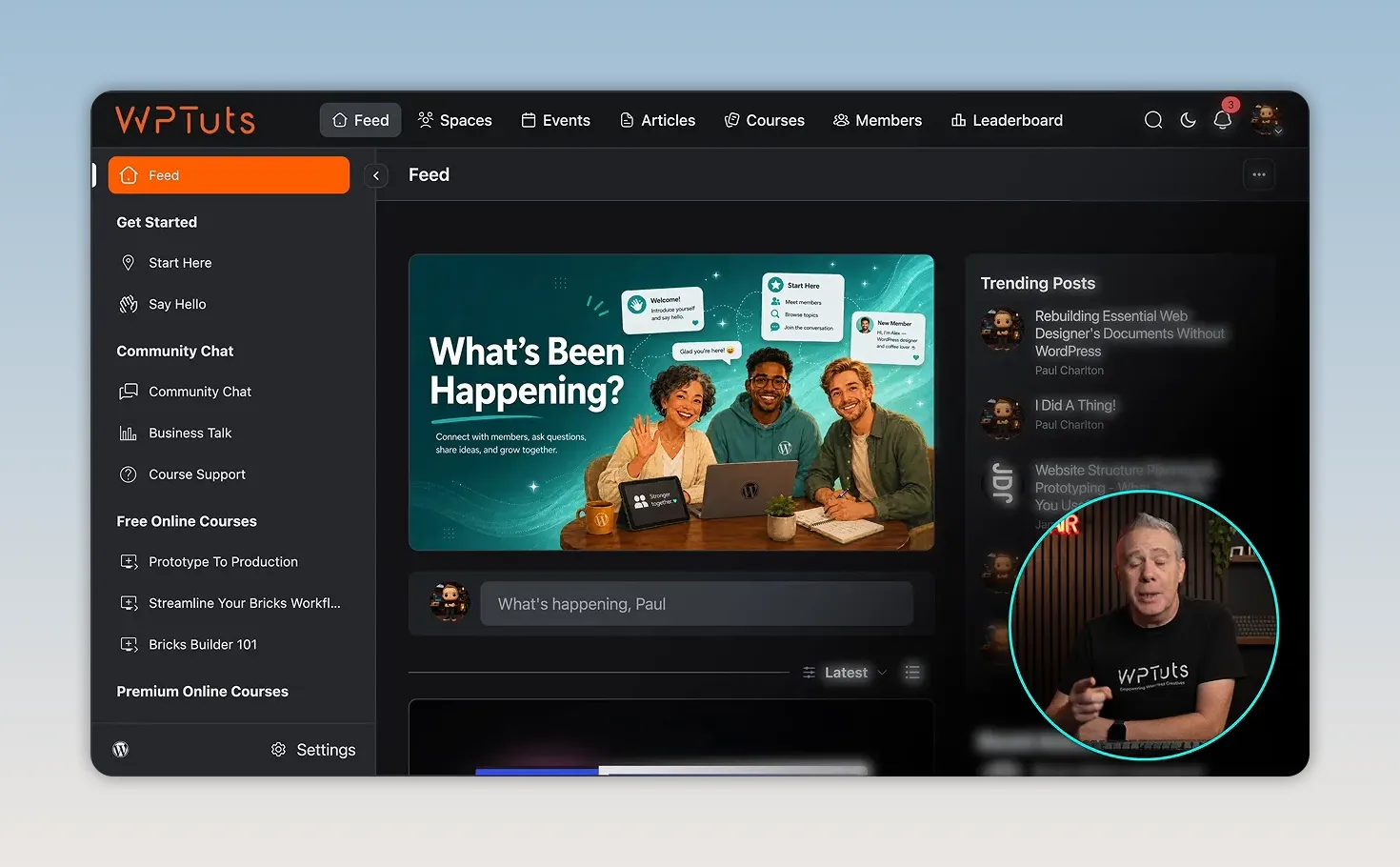
I am not interested in teaching a platform that I no longer use myself. WordPress remains part of my work, and I expect to keep building WordPress websites when it is the appropriate choice.
Why Explore Astro and Other Website-Building Tools?
Alongside WordPress, I will be looking at technologies such as Astro and tools including Sitereal, Instatic and Phantom Studio.
The attraction is not simply that they are different. It is the possibility of working in ways that better suit particular projects, including using AI to help with website creation and migration.
Consider an existing WordPress website that no longer needs to be on WordPress. You might prefer a different approach, but manually recreating the site could take more time or budget than you have available.
Or perhaps you have a client whose website does not need everything their current WordPress setup involves. They are not going to pay for a full rebuild, but you are still dealing with updates, maintenance and the ongoing work that comes with it.
If a suitable workflow lets you spend a couple of hours making a change that reduces that burden over time, it is worth investigating.
That does not mean every site should move. My approach is straightforward:
- Keep WordPress where it continues to serve the project well.
- Investigate alternatives where they could reduce unnecessary upkeep.
- Consider whether AI can make a useful migration practical within the available time and budget.
Part of my job is to spend time testing those possibilities and share what I find. You should not have to spend several hours on every new tool just to discover whether the process could work for you.
The WPTuts Name Is Staying
Whenever I discuss moving a website away from WordPress, the obvious question follows: does that mean WPTuts needs a new name?
Right now, the answer is no.
WPTuts is the brand I have built over more than eleven years. It is what people know, and WordPress is still part of what I cover. Starting again with a completely different identity would not make much sense.
Could that change in the future? Possibly. But there is no intention to rename WPTuts at this point.
What Still Excites Me About WordPress
Here is the honest part: WordPress itself does not excite me in the way it once did.
From my perspective, progress in the core product has felt slow and limited. Gutenberg and full-site editing are not things I feel particularly enthusiastic about.
That is my view, not a claim that nobody should care about them. What interests me is what I can build with the tools that sit on top of WordPress.
A community platform. An online shop. A page builder that gives me the freedom to create the design I want. AI connections and MCP workflows that open up different ways to work. Those are the things that get my attention.
WordPress is the foundation that allows those tools to run. It is a means to an end, and that is a perfectly useful role for it to play.
In practice, focusing more on the tools around WordPress is not a dramatic departure. That has already been a large part of WPTuts for quite some time.
A Broader Focus, With the Same Purpose
The future of WPTuts includes WordPress and Bricks. It also includes AI, alternative technologies and honest discussions about which approaches are worth our time.
I do not want to stay with a tool purely because I have always used it, and I do not want to replace a working solution simply because something new has appeared. The useful middle ground is to test, understand and choose what makes sense for the work.
That is the direction: the same enthusiasm for teaching, with room to explore how web design is changing.
The WPTuts Community is also a place to continue those conversations. Nearly 2,000 people have already joined, and the aim is a friendly environment where we can discuss tools, ask questions and learn from one another.
|